

If you work with older adults in any capacity—as a support worker, healthcare provider, or informal family caregiver—chances are you will encounter someone affected by dementia. Over 650,000 Canadians live with the condition, and that number is expected to grow to one million by 2030.
To provide effective care, you need to understand what dementia looks like in daily life and how to respond with compassion and confidence.
In this post, we walk through what dementia actually is, how it affects the adults you support, and what skilled care actually looks like in practice.
TABLE OF CONTENTS
- What is Dementia? Understanding the Basics
- How Dementia Affects Older Adults and Those Around Them
- Key Skills for Supporting Someone With Dementia
- Ethical and Practical Considerations in Dementia Care
WHAT IS DEMENTIA? UNDERSTANDING THE BASICS
Dementia is not a single disease. It’s an umbrella term for a group of conditions that cause a progressive decline in cognitive function severe enough to interfere with daily life.
The most common form is Alzheimer’s disease. Others include:
- Vascular dementia: Occurs as a result of reduced or interrupted blood flow to the brain
- Lewy body dementia: Caused by abnormal protein deposits that disrupt brain function
- Frontotemporal dementia: Affects the frontal and temporal lobes, leading to marked changes in personality, behaviour, and language
What these conditions share is their impact on the brain—and through the brain, on nearly every dimension of a person’s life.
The changes associated with dementia may include:
- Memory loss (particularly of recent events)
- Confusion about time or place
- Difficulty with planning or problem solving
- Challenges with language
- Anxiety, depression, or irritability
- Functional difficulties like managing medications, preparing meals, navigating familiar environments, or following a conversation
“As dementia progresses, people can become forgetful and confused, which can lead to frustration and even aggression,” says Kompass gerontology instructor Mickey Daye. He’s a registered nurse with 15 years of experience caring for adults with dementia.
“Caregivers need to learn how to deal with those affected by dementia to try to maintain a calm environment. You must have patience and avoid and/or deescalate the amount of frustration in the environment.”

Caring for people with dementia can be a challenge
HOW DEMENTIA AFFECTS OLDER ADULTS AND THOSE AROUND THEM
Someone living with dementia may struggle to make sense of a world that increasingly feels disorienting or unfamiliar. Faces they should recognize may not register. A home they’ve lived in for decades may not feel like theirs. A simple errand can become an exercise in confusion and frustration.
The emotional, social, and practical impacts are significant. Social isolation is common, as dementia can make conversation and community participation more difficult. The person may withdraw, or may be inadvertently excluded as others become uncertain how to engage with them. Loss of independence can bring grief, frustration, and a diminished sense of self.
Caring for someone with dementia is emotionally demanding, physically tiring, and often unpredictable. Family members may grieve the changes in their loved one while still providing daily care. Support workers may encounter behaviours they find difficult to navigate without the right knowledge and skills.
“Caregivers often don’t understand how dementia is going to affect their loved ones and the family unit. They don’t understand some of the strain it will put on the family as far as the care that they will eventually require,” says Mickey.
“It’s not just that they lose their cognitive abilities. It’s also a decrease in physical functioning, in psychological awareness, and in social interactions. It can be a dramatic decline.”
Research shows that informed, person-centred support makes a measurable difference. When the people around an adult with dementia understand what’s happening and how to respond—with patience, knowledge, and genuine care—quality of life improves. Distress decreases. Difficult moments become more manageable.
KEY SKILLS FOR SUPPORTING SOMEONE WITH DEMENTIA
Caring for people with dementia requires seeing the whole person and adapting to meet them where they are.
Person-Centred Support
Person-centred care starts with a simple premise: the person with dementia is still a person. They have preferences, values, and strengths, and those things don’t disappear with a diagnosis.
In practice, this means taking time to learn who someone is: what they’ve done for work, what they love, what brings them comfort, what matters to them. It means focusing on what a person can do rather than cataloguing what they can’t. It means supporting choice and dignity even when the choices are small—what to wear, what to eat, how to spend an afternoon.
Person-centred care is also an antidote to the depersonalization that can creep into care settings, where efficiency and routine start to override individual needs. It’s a commitment to seeing the human being first.
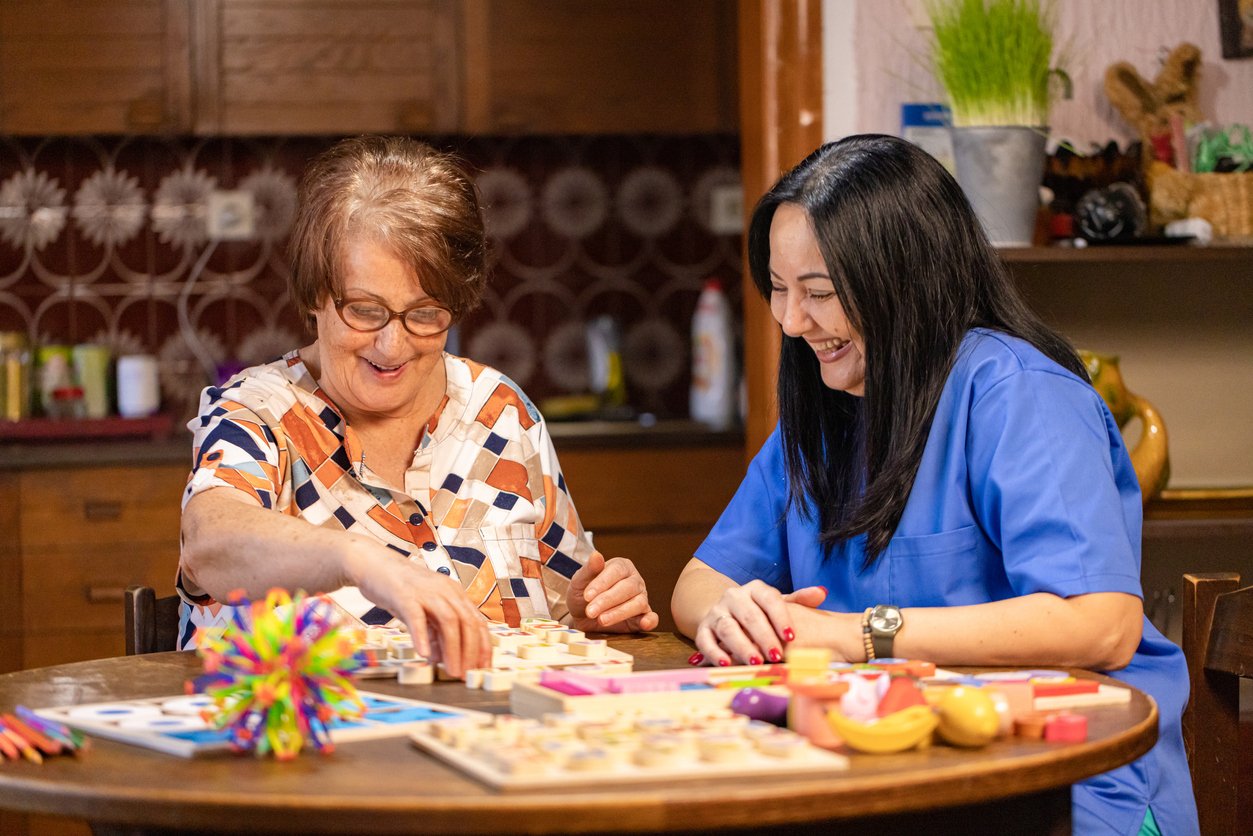
The right approach to dementia care can improve patients' quality of life
Communication That Builds Trust
Communication is one of the most important tools in dementia care. It’s also one of the most frequently mishandled, though usually without any bad intent.
As dementia progresses, the brain processes language differently. Words may not land the way they’re intended. Complex sentences, abstract concepts, and rapid speech can create confusion or anxiety. Adapting your communication can help:
- Use shorter, clearer sentences
- Speak calmly and at a measured pace
- Give one idea or instruction at a time
Perhaps most importantly, respond with empathy rather than correction. When someone with dementia is confused or says something that isn’t factually accurate, resist the urge to contradict them. Gently redirecting almost always produces better outcomes.
Understanding and Responding to Behaviour
This is, for many support workers, the most challenging dimension of dementia care.
Behaviours that appear disruptive or distressing—like repeated questions, wandering, or agitation—are often expressions of unmet needs. That could be discomfort, fear, pain, overstimulation, loneliness, etc.
Developing the habit of asking “what is this behaviour telling me?” shifts the entire dynamic. Instead of responding to the behaviour itself, you begin looking for the underlying need.
- What triggered this?
- What was happening just before?
- What does this person typically need when they act this way?
Understanding the need helps you figure out a response:
- Remove or reduce the trigger
- Offer comfort and reassurance
- Address unmet physical needs—hunger, thirst, pain, the need to use the washroom
- Adjust the lighting, noise level, or number of people around
- Engage the person in something meaningful or familiar
“The biggest thing is staying calm in a situation,” says Mickey. “If you get worked up and excited, it can escalate the situation. So, stay calm, use a quiet voice, and get face-to-face on a nonthreatening level with them. Therapeutic touch can also be a great tool if deemed appropriate in the situation.”
ETHICAL AND PRACTICAL CONSIDERATIONS IN DEMENTIA CARE
Supporting adults with dementia often involves navigating complex ethical and practical issues.
One common tension is between autonomy and safety. People with dementia retain the right to make decisions about their lives, even when those decisions involve some risk. Respecting that autonomy is both ethically important and practically challenging.
Another issue involves consent and capacity. Capacity is decision-specific and can fluctuate—a person may have capacity to make some decisions but not others, or may have greater clarity at certain times of day. Knowing when and how to support decision making, or involve substitute decision makers, is essential.
Those who care for adults with dementia must also be able to recognize signs of elder abuse or neglect. This population is among the most vulnerable to abuse because of cognitive impairment, social isolation, and dependence on others. Support workers need to know the signs and understand their responsibility to report.
BUILD YOUR DEMENTIA CARE SKILLS THROUGH TRAINING
The online gerontology certificate from Kompass Professional Development is designed to give those who work with older adults the knowledge, skills, and confidence to provide high-quality care. The program covers the aging process, dementia and cognitive health, ethics, and much more.
Click below to explore the program and chat live with an admissions advisor. We’re here to help!