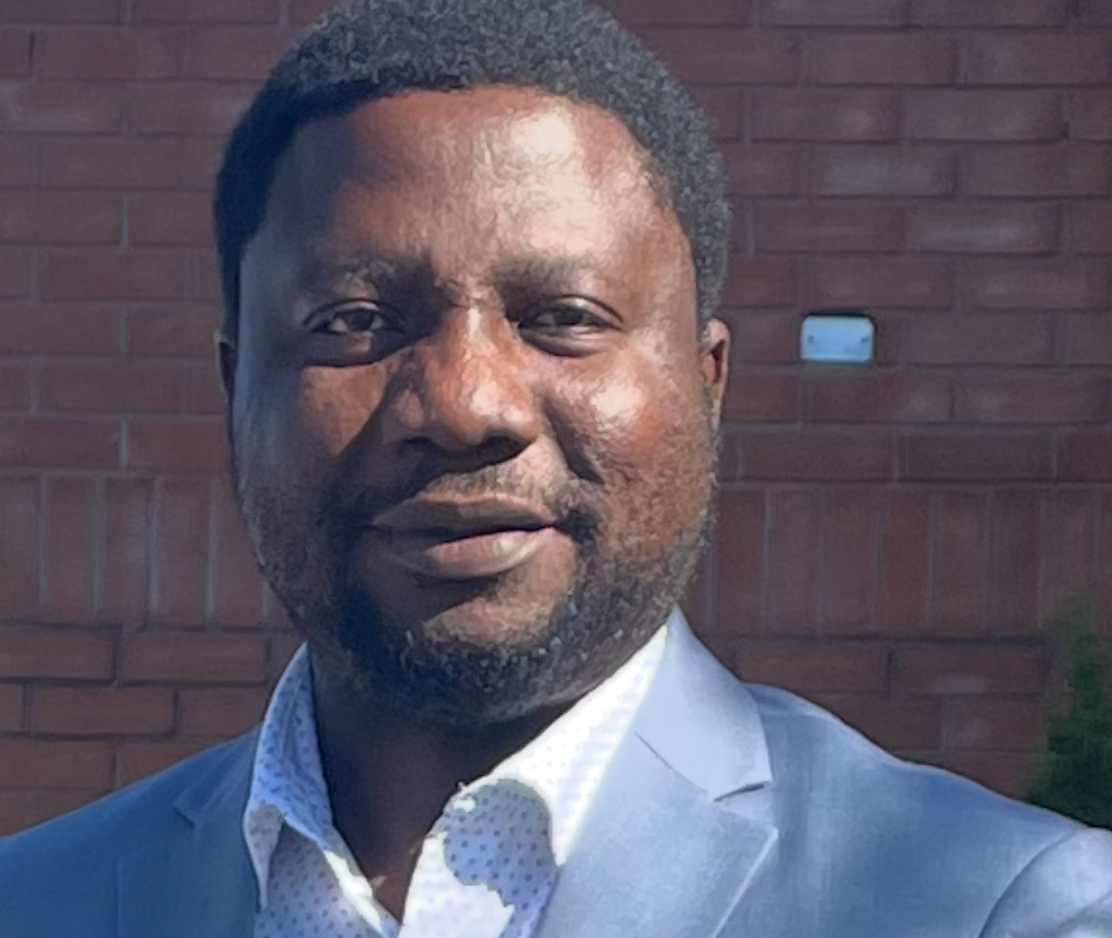
Eric Obeng has spent almost two decades keeping workplaces safe. His work has spanned sectors like manufacturing, construction, health care, mining, oil and gas, and government, on three different continents. He holds numerous professional certifications, including Canadian Registered Safety Professional. More recently, he earned his PhD in occupational health and safety, with research on what it really takes to make safety management systems work.
All that expertise goes straight into his classroom. Eric was the first occupational health and safety instructor at Herzing’s Ottawa campus, where he has been inspiring students for over six years.
We connected with Eric to talk about he got started in his career, what his PhD research involved, and why he tells every student to keep learning.
Q. How did you first get into occupational health and safety?
Eric: My dad was an engineer in a U.S. company in Ghana that refined oil and smelt aluminum. He was always coming home with weekly safety newsletters that he would read and put down. So from the time I was about six, I started reading about safety precautions and how to keep the environment safe.
I did my bachelor’s degree in mechanical engineering at the university in Ghana and was posted to an oil refinery. They put me in the safety and environmental department, so that was where it all started. I learned about the principles of safety, I learned about policies, I learned about safety communications and safety training.
Then I had a scholarship to go to Scotland to do my master’s in environmental science. While I was there, the council needed a couple of students to start a recycling program, so they came to the school to do interviews. During the interview, they saw my interest in safety, so instead of putting me in the environmental department, they put me in the safety department. I worked in the council as a safety inspector, going around to the various organizations to make sure they were in compliance with the applicable safety regulations.
I came to Carleton University in Ottawa in 2010 to do environmental engineering, which I really wanted to do. Environmental goes hand in hand with safety. Most of the principles and concepts in environmental science apply in health and safety, so anybody who has done environmental science or engineering tends to be a very good safety professional.
In 2025, I achieved my PhD in occupational health and safety through Capitol Technology University in Maryland. I studied remotely, but also travelled to the U.S. to do presentations.
Q. How did you end up teaching?
Eric: I saw a job posting at Herzing College six years ago and thought this was a very good opportunity for me. I’ve always loved teaching. My mom was a teacher and I’ve been a teaching assistant throughout my life.
So I went for an interview at Herzing and it was very competitive. We did an in-person interview, then a presentation. I was picked to be the first OHS instructor for the Ottawa campus.
I started with five students. The next batch grew to 20 students, then 80. We now have three instructors and almost all of my classes have more than 30 students.
A lot of students say they really enjoy the course. I’m still in contact with many of them and we meet in conferences and such.
Q. What did your PhD research focus on and how would you explain it to someone outside the field?
Eric: My PhD topic was effective implementation of safety management systems.
The safety department has objectives, like staying compliant with safety laws and preventing incidents from happening. So we need a mechanism that will help us achieve those objectives. That mechanism is called a safety management system.
My PhD focuses on how to effectively implement that mechanism. At a lot of workplaces, they have the objectives, but they don’t know how to get that mechanism to work. So there are violations of regulations and they have fines and injuries because they don’t know how to effectively implement that.
You can have the theory, but when the rubber hits the road, you are working with people. How do you bring together the theory with the people and the resources to form the system to create a safe environment? So my PhD was focused on the people, resources, and theory coming together to create a very effective system to reduce incidents in the workplace and also to stay compliant.
Q. Did your research come out of problems you’d seen in your own work?
Eric: Yes. I was exposed to a lot of organizations that liked the idea of maintaining a safe environment and staying compliant, but the steps to be able to do that were very difficult. There is a lot of bureaucracy, especially in government organizations, and the safety culture is lacking in a lot of organizations.
Also, every organization is different. The fact that I’ve been able to implement something in one organization doesn’t mean that I can carry the same system into another one because you have different people working there and you have different management systems and different organizational cultures.
So you need to study the organization. What is working? What are they doing right? What can I leverage to be able to make sure that what I’m implementing is well understood and the people are really following it?
Q. How do you incorporate real-life examples in your classes?
Eric: Everything I say in class is what I have done.
For instance, I have in real life investigated an incident with the City of Ottawa where a garbage truck hit one of the bin collectors. We wanted to find the root cause of the incident to keep it from happening again.
We did witness interviews and went to the site and took pictures. We also did a document review, looking at the driving record and training record of the truck driver. We gathered all that information to help us make a recommendation.
In every course that I do, I picture myself in the field, then I write down what I’ve done and how the students would really learn from it.
Q. How has workplace safety changed over the past few years?
Eric: The big change now is psychological safety. Ever since COVID hit, safety has been focusing on how people feel in the workplace. We know that when we put preventative measures like guards on machines, that helps, but that’s not the end of the story.
We also have to consider psychological hazards. If a stressed-out worker is using a machine, there can be an accident. So when people come to work, what is their condition? What are they thinking about? Do they have good work-life balance?
We are looking more into the human cause of accidents these days even more than the machines and equipment and materials. I think the trajectory is moving more toward the human factors than the environmental factors.
Q. What advice would you give a student who was thinking about going into the OHS field?
Eric: Be ready for continuous learning. The fact that you know something today doesn’t mean you should not keep learning because everything is changing. Even with my PhD, I have to be learning to update myself and make sure that whoever I am the safety professional for, I’m updating them on changes and stuff.
LEARN MORE ABOUT OHS TRAINING AT HERZING
Herzing’s Occupational Health and Safety program is taught by instructors who bring real field experience, and real credentials, to every class. Get practical training in incident investigation, safety management systems, and regulatory compliance, and graduate ready to work in a range of industries.